

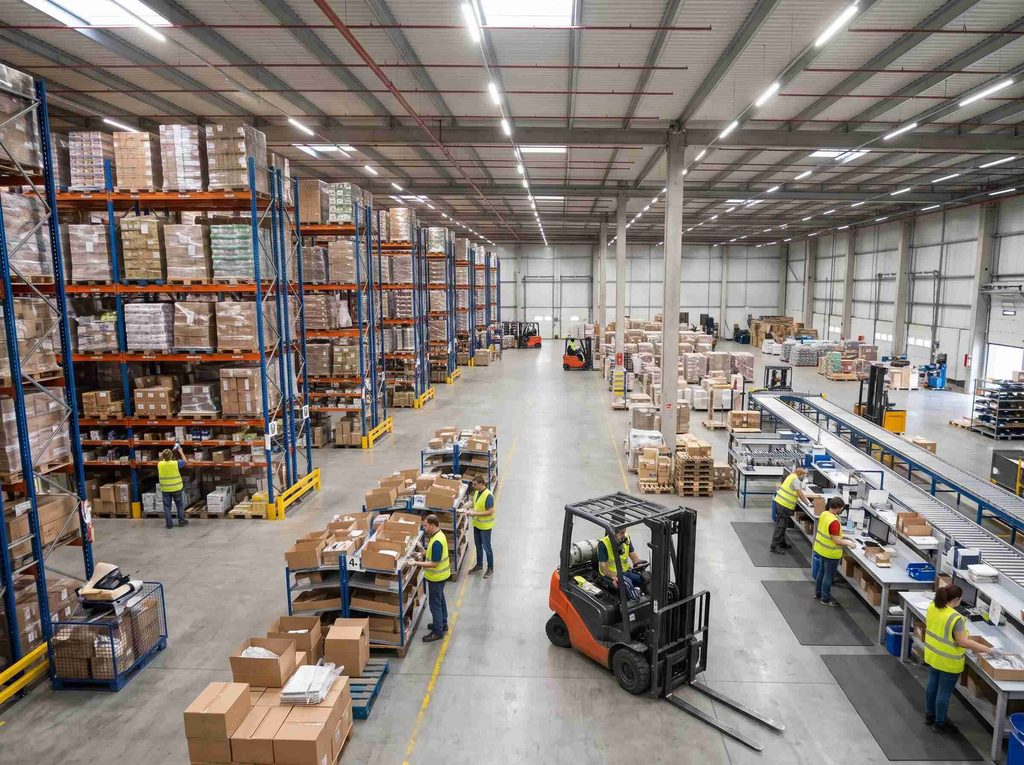
A good third-party logistics site needs to do much more than simply store stock. It has to receive goods quickly, move them efficiently, keep them organised and get them back out again without unnecessary delays. When several clients, product types and delivery schedules are involved, even small inefficiencies can quickly become expensive.
That is why the strongest 3PL sites are designed around movement from the beginning.
Start with the Loading Area
The loading bay is one of the busiest parts of any logistics operation, so its design needs to reflect that.
Vehicles should be able to manoeuvre safely, while pedestrians should be kept away from unnecessary risk. The Health and Safety Executive (HSE) also highlights the importance of considering visibility, vehicle and platform heights and the amount of space available around loading bays.
The equipment used should also match the range of vehicles visiting the site.
A warehouse handling everything from vans to articulated lorries may need more flexibility than one receiving a predictable fleet. Modular docks, complete with levellers, bridge plates and specialist loading systems can help compensate for differences in vehicle height and create smoother movement between trailers and the warehouse.
Also Read: How to Improve Productivity in Logistics
Keep Goods Moving Efficiently
Once stock enters the building, unnecessary handling should be kept to a minimum. Storage areas, packing stations, dispatch zones and loading bays should follow a logical sequence. Productivity suffers if pallets repeatedly need to be moved back and forth. Clear routes also make life easier for forklift operators and warehouse staff.
The way goods move vertically also needs particular attention. Relying on unsuitable manual handling methods can slow the operation and create additional risk.
Specialist equipment such as warehouse lifts and scissor lifts can provide a controlled way of moving pallets, roll cages and other goods between levels. It’s wise to invest in modular loading and lifting systems for raised docks, mezzanines and split-level warehouse environments.
Make the Site Work for Different Vehicles
A successful 3PL provider may need to accommodate very different transport operations in a single day. One client might send conventional articulated trailers, while another relies on vans or double-deck vehicles. Designing loading infrastructure around only one vehicle type will create bottlenecks later.
Flexible loading systems can make it easier to serve multiple vehicle heights from the same site. Vehicle-to-ground systems, for example, can be designed to load everything from vans to double-deck trailers at level-access facilities.
That flexibility can become increasingly valuable as contracts and transport requirements change.
Use Space Intelligently
Warehouse capacity is not only about floor area. High ceilings, mezzanine floors and underused loading areas can all increase usable space without moving to a larger building.
The challenge is making that extra space practical. Creating another level is only useful if stock can move between floors quickly enough to support daily operations.
Storage locations should also reflect how frequently products are handled. Fast-moving goods need easier access, while slower-moving stock can occupy less convenient areas.
Build with Change in Mind
Third-party logistics can change quickly. A new contract might introduce different pallet sizes, higher order volumes or an entirely different vehicle fleet. Seasonal peaks can also put sudden pressure on loading capacity and storage. Where possible, equipment and layouts should therefore leave room for expansion.
Modular loading systems can be particularly useful because they can sometimes be installed or adapted without the level of structural work associated with permanent built-in systems.
Also Read: The Ultimate Guide to Choosing the Right Logistics Company
Design Around the Entire Operation
The best 3PL sites do not treat docks, storage, lifts and dispatch areas as separate pieces. Each one affects what happens next.
A fast loading bay achieves little if goods immediately hit a bottleneck inside the warehouse. Equally, excellent storage systems cannot compensate for vehicles spending too long waiting to unload.
3PL operators can create facilities that are safer, faster and much better equipped to handle growth by designing the site around the complete journey of the goods, from vehicle arrival through storage and picking to final dispatch.